

HUMAN
LEAGUE
DARE TO DREAM .. PLAY TO WIN
MCQMUSICMONTHLY SEPTEMBER 2026 : ISSUE 338
The early 80s music scene in the UK, was described by Malcolm McLaren as 'a pantomime .. a period full of kids dressing up for the sake of it' .. aka the Blitz Crowd. Which could be regarded as somewhat of a disappointment, given that by the end of the 70’s Punk had kicked extravagance hard in the balls .. yet come the 80s it was back. Bigger than ever.
It had become a time obsessed by celebrity. A plethora of glossies and red top publications salivating over the current and/or next flavour of the month having sprung up in its wake.
Over time bands would transition from the threads of the Blitz kids to pastel coloured tailored suits. Duran Duran prime amongst them. Bowie .. all custard coloured threads and hair.
Musically, it was also the era of pop synth.
Stepping into this world at the tail end of 1981 were a re-purposed Human League. BOLD AS BRASS.
Phil Oakey’s barnet and high-heels aside, they dressed and sounded like the punter on the street. Their image attainable and attained. A connection with the British public was quickly established.
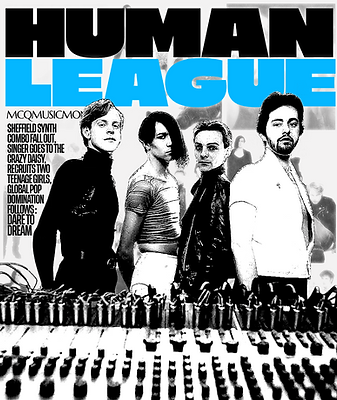
When The Cosmic Boogie Boys Ruled Britannia
When The Cosmic Boogie Boys Ruled Britannia
Which is somewhat ironic, given founding members Martyn Ware and Ian Craig Marsh (no longer with the band at this point) asked Phil to join the band, on the basis of his appearance rather than musical ability - he'd only mastered a few notes on an old saxophone to that point. Well, what does one do when Glen Gregory's not available and Phil, a presence around Sheffield for a couple of years, was hovering in the wings.
Okay, ready, let's do it ..
Yet, when computer operators Martyn Ware and Ian Craig Marsh formed one of, if not, Britain’s first all-electronic band in 1977, it was under the achingly apt name The Future.
-
Perhaps it was their name, and not the actual future, Bowie was referring to when he emerged from a ‘League’ support slot on the Siouxsie and the Banshees tour of December 1978 and informed the NME that he “had seen the future of pop music.“ Just putting that thought out there .. you never know.
Working out of a disused cutlery workshop in the centre of Sheffield, the group ran a full Roland System 100 setup and used completely electronic instrumentation, no guitars, no drums. They leaned on a DIY punk sensibility, applying it to electronics and built pop structures out of it. Two singles on Fast Product, the label of Bob Last, who became their manager, led to a deal with Virgin Records and the release of two albums; Reproduction (5 October, 1979) and Travelogue (16 May, 1980). Dark, menacing and brooding, both albums cemented the feel of Steel City kitchen sink sci-fi the band excelled in. A sound subsequently described by Jarvis Cocker as the sound of “spacemen (putting) the rubbish out”, According to Martyn Ware, Travelogue’s sound originated when the band soaked up Sheffield’s omnipresent “sound of industry”.
Though Travelogue did hint at a commercial shift, they didn’t go as far to include I Don’t Depend On You, a track released under the pseudonym The Men in July 1979. Oakey's vocal with female backing from Katie Kissoon and Lisa Strike hinting at the path Phil would eventually travel. Unfortunately for the band, a lack of sales for either album and single, Empire State Human, resulted in Virgin cancelling the boys December ’79 tour
I’ve had my hard times (hard times!) in the past ..
When sales did not match the good reviews, Martyn and Phil clashed constantly. The tour cancellation rankled somewhat, especially when the Human League's role as UK electronic pioneers was usurped by Gary Numan and his Are Friends’ Electric? success. Even The Undertones took the piss, when the lyric .. “His mother bought him a synthesiser / Got the Human League in to advise her / Now he's making lots of noise / Playing along with the art school boys" .. name-checked the band before they’d even charted.
Needless to say the clashes created a rift within the band, with Phil on one side and Ian and Martyn on the other. Things eventually came to head when one day when Martyn arrived at the studio to be confronted by Oakey and Bob Last, who told him they were going to kick him out of the (his) band. And so, in October 1980, the group split. Ware and Marsh left to start Heaven 17. Oakey remained, kept the name*, and vowed to plough on alongside Adrian Wright, who had originally joined as “Director of Visuals,” running lighting and slideshows for live shows. Adrian would learn keyboards out of necessity following the split.
-
*Oakey and Wright were allowed to keep the name on the condition they took on all pre-split debts and commitments.
And so, with a European tour booked, Oakey needed to rebuild the band .. and fast. What better way to do that, than head down the Crazy Daisy (Sheffield nightclub of choice for the locals at that point) and recruit two teenage girls, Joanne Catherall and Susan Ann Sulley, that you’ve spotted on the dance floor.
Luckily for Phil, the girls were fans of band and recognised him. Ironically, the girls even had tickets for the bands upcoming Doncaster date. Within weeks they’d find themselves on that very stage, their first appearence with the band, having cans thrown at them .. the ‘hardcore’ male fans having bought tickets with the expectation of seeing the original line-up. At this stage the girls were no more than guest vocalists on a salary of £30 a week.
-
Phil Oakey: “.. I had intended to recruit just one female backing singer but when I walked into the Crazy Daisy nightclub in Sheffield, the first thing I saw was Joanne Catherall and Susan Ann Sulley dancing. They somehow looked like a unit while being clearly different individuals. I knew they were right .. “
-
Susan Ann Sulley: “ .. When Philip came over to ask if we’d like to audition, we told him we were doing our A-levels so would have to ask our dads. My dad thought it would be sex, drugs and rock’n’roll, and both sets of parents refused, but we secretly auditioned anyway and then arranged for Philip to come over to meet our parents, but didn’t tell them he was coming until the last minute. He turned up fully made up with red lipstick and high heels, but very businesslike. My dad locked himself in the bedroom and refused to come out. Years later I found out that my grandma told him: “If you don’t go downstairs and give your daughter this chance, she will never forgive you.” And my dad then bundled us over to Joanne’s to persuade her father .. “
Also recruited into the fold were former Rezillos guitarist Jo Callis (at that point the Rotherham lad was flying solo having seen previous band, Shake, split after two singles), and Ian Burden (previously employed as a session keyboard player for the League's October 1980 tour .. as a trained musician, Burden was not only a far superior keyboard player to Oakey or Wright, but he also brought further songwriting skills to the group).
Alsatians fall unconscious at the shadow of your call ..
Due to the atmosphere at Sheffields, Monumental Studios, the studio the new version of Human League shared with Heaven 17 (newly formed by Ware, Marsh and Glenn Gregory), the band relocated to Genetic Sound Studios in Reading on the suggestion of Virgin Records (studios owned by producer Martin Rushent).
Prior to the location shift, the new line-up recorded and released standalone single, Boys and Girls. Penned by Oakey and Wright, it was the first single released by the new line-up. Although Sulley and Catherall didn’t perform on the record, they did find themselves featured on the picture sleeve.
-
The girls had returned to school .. The single would peak at number 48 in the UK Singles Chart.
Martin Rushent was a veteran. Battle-hardened. A decade of professional experience working with the likes of Stranglers, Buzzcocks, XTC and (oddly enough) The Rezillos. He was also passionate about new technologies, and in his studio, the band found the perfect environment for their new sound. Rushent also appeared to be the right person to define it, even if Oakey was anxious about writing a new record .. “I thought we were going to fail and everyone was going to laugh in our faces.”
The first results of their collaboration, The Sound of the Crowd, emerged in April ’81, and nestled nicely just outside the UK Top Ten. The track was derived form a recording process that could be seen as beyond plain. No overdubbed guitar solos, no live drum kit, just direct, minimal synth programming doing the entire job a full band would normally handle. What Rushent turned The Sound of the Crowd into remapped the world of pop music. He programmed a song of minimal potential into a chain reaction of synthesiser and drum patterns, pulsing together in white space. Gary Numan aside, nothing on the radio sounded quite like it.
Crowd was quickly followed by top 10 singles Love Action (I Believe In Love) and Open Your Heart before third album, Dare, dropped on 16 October 1981. All seemed a fair distance from Being Boiled (which also became a huge hit in early 1982 on the back of Dare’s success).
I reached for the one with the ultra-modern label ..
Beyond the singles, Dare had enough for the old fans, and whistleable tunes for the new. There's the broad sweep of magnificence that is opener Things That Dreams Are Made Of which signified the album’s intent, with Phil sinisterly intoning about ice cream; the portrayal of Judge Dredd in I Am The Law, which could’ve come from the first two albums had it wanted to sound like it; Do Or Die, with its digital congas and preposterously brilliant lyric; Darkness invents electro goth. Seconds, addresses the killing of JFK; whilst the Casio-tone re-make of Get Carter makes an appearence.
The album was a gleaming new dawn for The Human League, representing both their past and future in a gloriously glossy deluxe package. Quite an achievement, given Rushent would listen to the rough mixes when he returned home from the studio and couldn’t figure out whether the album they were making was brilliant or terrible.
Of course, Dare is best remembered for the glow of its singles. Singles which presaged the dawning of that new era in pop music, one where synthesisers and drum machines processed the flutter and ache of crushes, romance, and heartbreak. It's a remembrance that would be anchored by the success of the album's fourth single and final track, Don’t You Want Me. A track that sold over 1.5 million units, broke the band in the US, signalled the ‘second British Invasion’ and is credited with keeping Virgin Records afloat during a genuinely precarious moment for the label.
Richard Branson’s partner in crime, Simon Draper, saw what was happening with the album and it was clear to him there had to be a fourth single. And that single had to be Don’t You Want Me, something to which Oakey was totally opposed, viewing the track as weak and no more than filler. Fortunately, Draper’s unbeatable commercial criteria and keen sense of smell won out over Oakey’s stubbornness and on 23 November 1981 Don’t You Want Me hit the shelves of UK record shops. Result. Five weeks at number one in the UK charts, including the coveted Christmas Number One.
-
For the lyric, Phil rewrote the plot to A Star Is Born as a duet of intra-band drama between himself and Sulley. It’s perfect in its simplicity: a thick fog cast by the opening synth line, Oakey’s stone-faced gloom quickening into desperation in the transition from the verse to the bridge, the way Sulley’s voice gets shaky as if it’s feeling the desolate cold of the song. They ask each other the same question, yet the disconnection between them is so profound that neither person can hear it, a lonely signal sent into a darkness as vast and quiet as space.
In the space of twelve months, they’d gone from spending the festive period in the studio trying to work out Boys & Girls, to being the Christmas No.1. Within the first six months of 1982 they’d crack North America and reach No.1 there too.
With your looks you could go far ..
Oddly, the League didn’t get to participate much in the strain of pop they helped develop. (Keep Feeling) Fascination and Mirror Man were released over the next two years, but the sessions for the follow-up, 1984’s Hysteria, proved so torturous and overextended that Rushent abandoned his role as producer and was replaced by Hugh Padgham. Next came an audacious detour to Minneapolis to work with platinum-plated R&B producers Jimmy Jam and Terry Lewis. Famous for their collaborations with Janet Jackson, Michael Jackson and Prince, the duo’s hands-on perfectionist methods created studio tension and uneven music, yet Human remains a left-field classic, earning the band their second US Number One.
Regardless, to us Brits, it’s those first three albums that define The Human League. Dare especially, as it bookmarks a time in many lives. Named as one of the most influential albums of recent decades, forty five years since its release, it, like Reproduction and Travelogue, remains an audio delight. Its producer as key to The Human League's sound as George Martin was to The Beatles and Quincy Jones to Michael Jackson.
As a band, The Human League have never fully abandoned their founding minimalism. Nobody would be shocked to learn they’ve kept every synth they’ve ever owned, the kit being holed up in a Sheffield studio somewhere, frequently pulled out for use, even though recording technology has changed over the years.
Despite their self-confessed limitations as musicians.
Despite multiple lineup changes.
Despite breakups and breakdowns
Despite career slumps.
Human League embarked on a journey from Bowie-endorsed synth-punk outsiders to multi-million-selling electro-pop superstars, which in itself, is worthy of recognition.
We delve into the band’s formative years this playlist.
ALSO THIS PLAYLIST .. on the new release front, there’s a further delve into Mike D’s solo debut and the lead track from Troye Sivan’s new long player. As for re-releases, the opening salvo from Primal Scream's Xtrmntr leads the charge, alongside Massive Attack's remix of the title track. The second of Primal Scream's ‘bunker’ albums is back amongst us - with Mani’s heavy baselines and Kevin Shields assault to the eardrums to the fore. Not to be out done on the reissue front, there’s a menagerie of Marley to be found on the long-awaited, Roots, Rock, Reggae. Live @ The Hammersmith Odeon .. Trenchtown Rock makes the cut.
ELSEWHERE .. there’s archive material from XTC and Yazoo; an overlooked gem from a pre-Into The Gap Thompson Twins and a little something from Magazine’s John Peel Sessions .. that little something being, The Light Pours Out Of Me, a track co-penned by Pete Shelley, which given Howard Devoto’s declaration upon leaving The Buzzcocks (“I want to do something more complex”) is in itself somewhat ironic, additionally when its guitar riff could be construed as a lift from Gary Glitter’s Rock and Roll (Part 2). How’s that for a tenuous link to the playlist’s opening track.
October is just around the corner, and that usually means a Police related anniversary. This year is no different, as Ghost in the Machine turns 45 on 2 October (forty five ffs !). Too Much Information may be centred around a multi-sax melody, but it’s a masterclass of Stewart Copeland snare snaps, snare rolls, hi-hat fills and percussive flair.
Our 'rounding things off' honour goes to sombr .. well, the lad is about to take the UK by storm next summer, so why not.
That's yer lot then .. Time to grab an old Roland System 100 and get some patch sheets out. A KORG 700S wouldn’t go amiss either.
MCQ returns next month.
Until then, we’ll be working on breathing techniques, specifically those that help with trumpet playing.
Enjoy.
Ed.
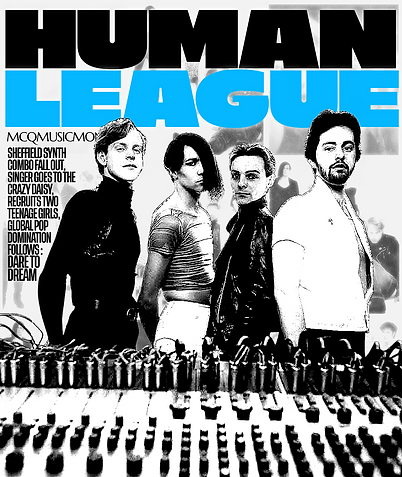
September 2026 Suggested Listening
THE HUMAN LEAGUE - MEDLEY: ROCK N ROLL / NIGHTCLUBBING
THE HUMAN LEAGUE - DO OR DIE
MIKE D - CRYPTO
THE HUMAN LEAGUE - MARIANNE
MAGAZINE - THE LIGHT POURS OUT OF ME
YAZOO - GOODBYE 70'S
THE HUMAN LEAGUE - THE BLACK HIT OF SPACE
PRIMAL SCREAM - EXTERMINATOR - MASSIVE ATTACK REMIX
THE HUMAN LEAGUE - THE SOUND OF THE CROWD
XTC - ARE YOU RECEIVING ME?
THE POLICE - TOO MUCH INFORMATION
BOB MARLEY & THE WAILERS - TRENCHTOWN ROCK
THE HUMAN LEAGUE - (KEEP FEELING) FASCINATION
TROYE SIVAN - SHE'S THE BEST
PRIMAL SCREAM - KILL ALL HIPPIES
THOMPSON TWINS - SLAVE TRADE
THE HUMAN LEAGUE - BEING BOILED
SOMBR - MY BODY ISN'T READY
Further Listening ..
HEAVEN 17 - PLAY TO WIN
GARY NUMAN - TELEKON
PETE SHELLEY - I GENERATE A FEELING
Next Issue October 2026
Please support the artists featured.
MCQMUSICMONTHLY


