“It’s been such a long time,” sings Boston’s Brad Delp – over and over again – on Foreplay/Long Time, the third track of the band’s 1976 self-titled debut. He’s not wrong. This week marks 50 years since the album landed, quickly becoming one of the best-selling debuts of all time.
Other self-titled debuts released in 1976 included generation-defining albums by Blondie, the Ramones and Tom Petty and the Heartbreakers. But while those three bands all went on to earn places in the Rock & Roll Hall of Fame, and are still hugely popular, Boston remain outside the velvet rope. Not only have Boston never been inducted into the Rock Hall, but today they’re virtually forgotten.
Which is strange, because Boston didn’t merely outsell those other albums – it ran record-playing, vinyl-spinning circles around them. It has sold more than 20 million copies worldwide. And its opening salvo, the air-punching More Than a Feeling, has never really gone away. Last summer, it broke one billion streams on Spotify; in 2021, Rolling Stone magazine yanked it 288 places up its ranking of its greatest songs of all time, from 500 to 212.
So how did a band that once seemed impossible to escape become so easy to overlook? John Boylan co-produced that first record with Boston’s founder, songwriter and sonic svengali Tom Scholz. To his ears, it was more than a phenomenon – it was a recording revolution. “In those days, music was sort of split in half,” says Boylan. “You either had a dark, heavy, blues-oriented sound, or a California country rock sound. Never the twain shall meet. Boston was the first record that I heard that had a metal sound to it but was melodic.”
The first time Boylan heard Boston, it wasn’t in a studio – it was coming down the street. The band’s future manager, Paul Ahern, was visiting in his Oldsmobile convertible, from which he was loudly blasting a cassette recording of the album. “I could hear it playing a block away,” says Boylan. From that cassette, he immediately knew he wanted to work with Scholz. He describes the guitarist as “a really brilliant guy. He had an advanced degree from MIT [the Massachusetts Institute of Technology], and was working for Polaroid when I met him. He understood more about electronics than I did”.
The “Boston sound”, which Boylan describes as “a feedback-induced rock ’n’ roll sound with a cool delay, and some phasing issues from double-tracking”, was developed using a collection of ingenious, Scholz-designed devices. “Not inventions, but rather clever adaptations of existing technology.” From the “Scholz Power Soak” to the Rockman amplifier, bands including Def Leppard and ZZ Top went on to record using the gear. (Both bands, incidentally, are also in the Rock & Roll Hall of Fame.)
The album cost just $28,000 to make and involved a little subterfuge, with Boylan running interference so Scholz could record most of it in his basement in Watertown, Massachusetts. In an era when ambitious rock records were made in expensive professional studios, Scholz wanted to do things his way. “Today, Billie Eilish can make huge hit records in her bedroom,” says Boylan. “Tom was a precursor to that – but in the analogue age.”
Only one track on the album, Let Me Take You Home Tonight, was recorded primarily at Capitol Studios in Los Angeles. But, even there, Boston found a way to make themselves at home. “We recorded the handclaps on More Than a Feeling in the men’s bathroom,” says Boylan. “We ran a wire down the hall, put a mic in there. It had a great echo.”
The album was an immediate hit, launching three singles (More Than a Feeling, Long Time and Peace of Mind) into the Billboard Hot 100. So what happened to all that momentum? Could what Boylan calls Scholz’s “perfectionism” – and his need for control – be the reason Boston never capitalised on their early promise? Former drummer Jim Masdea thinks so.
“Boston is a mystery,” he says. “And Tom Scholz is the Donald Trump of rock ’n’ roll. He’s not horrible, but he’s a narcissist. He believes it’s only him, that everything was only him.”
Masdea met Scholz in 1970, after the pair answered a classified ad for an MIT fraternity band called Freehold. After rehearsing with the band, the pair spent the next five years writing songs together, recording demos – refining what would become Boston’s debut album. Their final demo caught Ahern’s attention. “Tom was about to throw it in,” says Masdea. “His wife wanted to buy a house.”
But before the record deal was signed, Masdea was cut loose. He believes it was over his songwriting aspirations. “I tell Tom that I don’t just want to play songs, I want to write songs, to contribute songs to the album. I’m gone a week later.” The official explanation given for Masdea’s departure was that the band’s prospective managers, Ahern and Charlie McKenzie, felt a line-up change was necessary in order for Boston to sign with Epic Records.
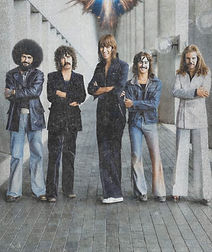
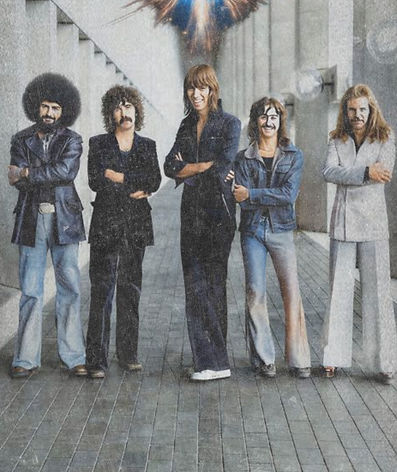
Masdea’s drumming can only be heard on one track, Rock & Roll Band. The rest of the drum parts were played by Sib Hashian, who joined Delp, bassist Fran Sheehan and off-and-on rhythm guitarist Barry Goudreau to form the final five. Turn the record sleeve over and there they are.
By the time the first 5,000 records were pressed and printed, Masdea had been relegated to the “special thanks” section – “Like I swept the studio floor!” It was a sign of things to come. “When Barry [Goudreau] wrote his first album in 1980, he was out too,” says Masdea.
“I didn’t leave of my own accord, let’s put it that way,” Goudreau explains. In 1980, the guitarist’s own self-titled solo album was favourably received by critics. This, he says, made Scholz “very unhappy”. “So when we got to the beginning of 1981, he got Boston back together and said: ‘I’m not going to work with Barry again.’ And at the end of that meeting, Brad Delp – who was my brother-in-law – announced that if I was out, he was out too.”
This has always been the Boston paradox. Without Scholz’s technical nous and songwriting, the band would never have made that smash debut. But the same control and singular vision that made Boston’s music so distinctive also turned the band into something of a revolving door. According to his detractors, Scholz – who declined to comment for this piece – never allowed other creative voices in, so Boston failed to develop the kind of collective, collaborative identity that Led Zeppelin, Queen or Aerosmith did.
“I think people see Boston as Tom’s project and, honestly, I think that’s true,” says Goudreau. “That’s the way it came together, I wouldn’t dispute that.”
After another Scholz standoff, both Hashian and Sheehan were out by 1983 – two more of the 25-plus musicians to pass through Boston over the years, if you count the proto-Bostons: Freehold, Middle Earth (Masdea was reading Tolkien at the time) and the faintly queasy sounding Mother’s Milk.
But their image was always an issue, says Boylan, largely due to their forgettable name. The Revolting Tones Revue was floated as an alternative option – hardly an improvement – before Boylan landed on Boston, inspired by Midwestern rockers Chicago. As Boylan puts it: “If they named their band after a city, why couldn’t we?” Looking back, though, the producer regrets not rustling up something with a bit more bite.
“Look, there wasn’t exactly a major brainstorm,” he says. “It’s a generic name, and the downside is that it doesn’t really spark any personality. Hear ‘Fleetwood Mac’ and you’d say, what’s that? Hear ‘Blondie’, and because the rest of the band isn’t blonde, you know that’s Debbie Harry. It’s interesting. Boston was too normal a name to stand out – although that’s just my personal opinion.”
He’s probably right. Ask anyone who wasn’t a teenager in the band’s heyday to name their favourite Boston song and they’ll probably struggle. Play them the cascading guitar riffs that open More Than a Feeling, though, and they’ll be humming along in no time. The music has outlasted the band – even the Boston album cover has a stronger foothold in pop culture than the group itself. A fleet of glowing, guitar-shaped spaceships, it was designed by Paula Scher, then a graphic designer at CBS Records.
“I had designed two covers that were visual puns on the name: a head of Boston lettuce and a Boston cream pie,” says Scher. “Big, round objects always look great on record covers. But the band wanted a guitar – I thought the idea was idiotic.”
Originally, the spaceships were to be causing devastation; management decided they should instead be evacuating the planet. Each was to bear the name of a city, with Boston in the foreground, but the band worried it would look like the album was called “Boston, London, Paris, Rome”. The other names were duly removed, and the cover eventually “struck a particular chord with teenagers”, says Scher. “It was a time of technological change, with satellites continually shot into space. It was that music and that graphic at that time.” And because Boston “originally didn’t have recognisable stars”, she adds, “the cover became the focus”.
Following the album’s massive success, the pressure started to ramp up for the band to deliver another commercial hit. “By the start of 1977, we were already headlining arenas, so there wasn’t much time or space to do anything else,” Goudreau says. “As soon as the tour finished, the record company said: ‘Where’s the next record?’ There was tremendous pressure on Tom. He’s quoted as saying he put it out before he really thought it was ready. And, of course, the success of the first record was so enormous – how could you hope to top it?”
Even so, Don’t Look Back sold more than a million copies in just over a week. But, Goudreau points out, Boston still had Delp at that point. “He was the secret sauce. One in a million. He had a great voice, great pitch and was so great at the harmony parts. Really, really amazing.”
First Boston lost Delp, then the world did. In 2007, the frontman died by suicide, having suffered with depression since he was a teenager. Former Boston fan Tommy DeCarlo took over vocal duties, remaining with the band until his own death from brain cancer earlier this year – 19 years to the day after Delp died.
Today, 50 years on, Boston have somehow slipped through rock history’s fingers. On Foreplay/Long Time, Delp sings another refrain in that stratospheric voice of his: “You’ll forget about me after I’ve been gone.” It’s oddly haunting hearing that line now. Because perhaps Boston’s strangest legacy is that, while the band has faded, the songs never have.
Please view the original Telegraph article via the link provided above.
MCQMUSICMONTHLY
FEATURE SEPTEMBER 2026 - 2026年9月